NEXOFEED / products
Assembly Machine Vibratory Bowl Feeder
In the wave of modern manufacturing pursuing efficient and precise production, automated assembly lines have become key for companies to enhance their competitiveness. As the core component of automated assembly systems, the assembly machine vibratory bowl feeder undertakes the i…
Evaluate with my part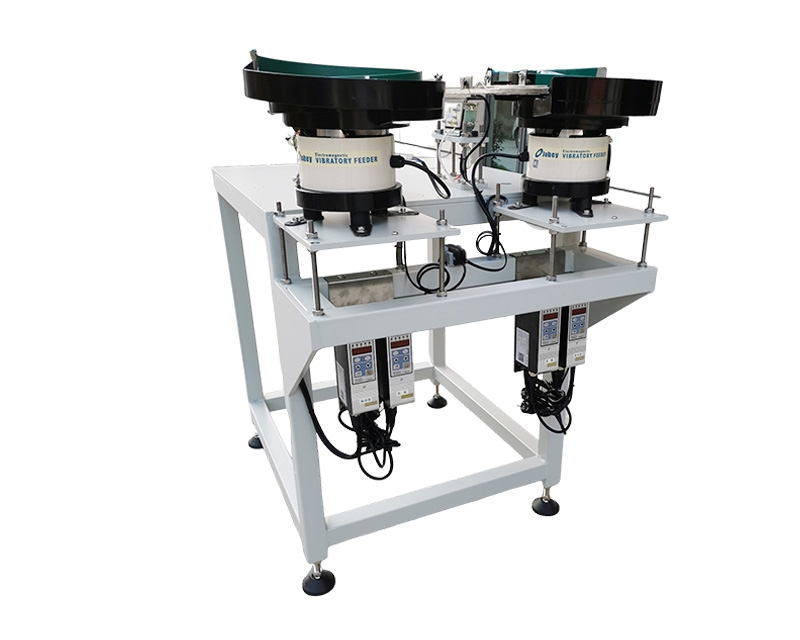
Overview
In the wave of modern manufacturing pursuing efficient and precise production, automated assembly lines have become key for companies to enhance their competitiveness. As the core component of automated assembly systems, the assembly machine vibratory bowl feeder undertakes the important tasks of automatic sorting and directional conveying of parts, acting like the "conveying hub" of the production line, transforming disorderly components into orderly assembly material flows. From 3C electronic products to automotive parts, from home appliance manufacturing to medical device assembly, the assembly machine vibratory bowl feeder leverages its unique technological advantages to provide solid assurance for the high-quality, efficient production of various products.
The operation of the assembly machine vibratory bowl feeder is based on mechanical vibration and precisely designed track systems, with the core goal of transporting messy components to the assembly station in specific postures and sequences. The equipment mainly consists of four modules: the hopper system, vibration drive module, track sorting mechanism, and control system. The hopper serves as a temporary storage space for components, usually made of high-strength metal or engineering plastic, with capacity customized according to production rhythm and part size. The bottom of the hopper is connected to a vibration drive module, which generates high-frequency vibrations through a vibrating motor or electromagnetic vibrator. When the vibration motor starts, the hopper generates vertical vibration and twisting motion around the shaft, giving the internal parts upward momentum. The track sorting mechanism is the technical core of the assembly machine vibratory bowl feeder. The spiral track surface is specially treated to have an appropriate coefficient of friction, ensuring the parts climb smoothly under vibration. Various shapes of sorting grooves, limit rods, and guide plates are distributed along the tracks. Through geometric matching and mechanical principles, parts are sorted and oriented. For example, for parts with bosses or grooves, the limiting structure on the track can jam specific areas, forcing the part to move forward in the correct posture; For thin sheet parts, airflow-assisted or flexible clamping structures are used to prevent parts from shifting or being damaged during conveying. The control system is responsible for adjusting vibration parameters and monitoring the conveying status of parts in real time through sensors. Common sensors include photoelectric sensors and proximity sensors, which are used to detect the quantity of parts in the hopper, track blockages, and the signal of part arrival at the discharge port. When the system detects abnormalities, such as part accumulation or material shortages, it automatically adjusts vibration frequency and amplitude or issues alarms to ensure continuous and stable operation of the assembly line.
The assembly machine vibratory bowl feeder uses precisely designed tracks and closed-loop control systems to keep part conveying accuracy within ±0.1mm. In mobile phone camera module assembly, the vibratory bowl feeder can deliver screws with a diameter of only 0.3mm at a specific angle to the fastening station, and together with the visual guidance system, enables precise screw implantation. This high precision not only reduces manual calibration steps but also significantly improves product yield rates. After an electronics manufacturing company introduced this technology, the defect rate of camera module assembly dropped from 3.2% to 0.8%.
When changing product models on traditional assembly lines, it often takes several hours to adjust equipment parameters. The assembly machine vibratory bowl feeder enables rapid switching of multiple types of parts through modular track design and intelligent parameter adjustment. For example, on an automotive engine assembly line, the same vibratory bowl feeder can switch between five different parts—including pistons and valves—within 15 minutes by replacing track inserts and adjusting vibration parameters, increasing production flexibility by 60%. This flexible design enables companies to quickly respond to market demands and reduce the cost of repeated equipment investment.
Compared to the intermittent and fatigue limitations of manual feeding, the assembly machine vibratory bowl feeder can operate continuously 24 hours a day. In the air conditioning compressor assembly line, a single vibratory bowl feeder can deliver over 2,000 components per hour, and with automated manipulators, it achieves an assembly cycle of 8 to 10 units per minute. At the same time, the built-in intelligent warning system of the vibratory bowl feeder can predict faults such as part blockages and motor overheating in advance, and through the remote monitoring platform, promptly pushes repair instructions, increasing the overall utilization rate of the equipment to over 95%.
Features
- Part-specific orientation tooling
- Adjustable vibration and flow control
- Line-integration-ready interface
Benefits
- Reduces repetitive manual handling
- Presents parts consistently to the next process
- Supports integration with automated equipment
PARTS
Supported parts
- Metal or plastic parts validated through sample testing
- Components requiring repeatable orientation
- Small and medium parts suitable for vibratory feeding
Want to evaluate this solution with your part?
Send photos, dimensions, orientation and rate. We will respond with the next technical questions.
Request a quote