NEXOFEED / products
Centrifugal Feeder
The centrifugal tray feeding machine is a widely used automatic loading device for entire rows in industrial automated production. It relies on the principle of centrifugal rotational dynamics to automatically sort, sort, and continuously feed scattered workpieces. Unlike traditi…
Evaluate with my part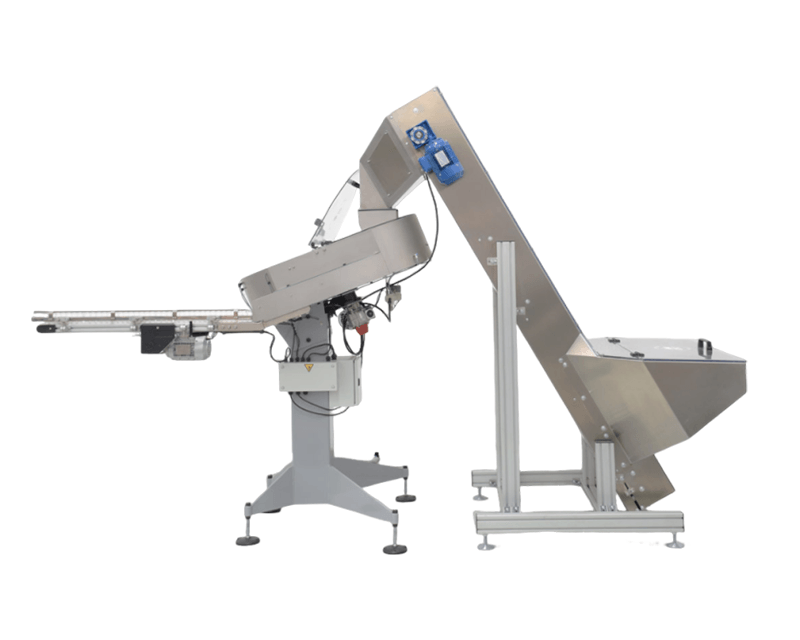
Overview
The centrifugal tray feeding machine is a widely used automatic loading device for entire rows in industrial automated production. It relies on the principle of centrifugal rotational dynamics to automatically sort, sort, and continuously feed scattered workpieces. Unlike traditional vibratory bowl feeder feeding modes, it operates with lower noise, faster feeding speed, and causes less wear on workpieces. It is widely suitable for automated feeding of small hardware parts, plastic parts, cylindrical and special-shaped components, and has become one of the mainstream feeding devices supporting assembly lines and precision machining equipment.
From the perspective of working principle, the centrifugal disc feeder is powered by high-speed rotational centrifugal force. The entire machine mainly consists of a rotating pan, drive speed control mechanism, directional sorting track, material guide device, frame body, and electronic control system. When the equipment is operating, the drive mechanism drives the circular material tray to rotate at a constant speed. The various scattered workpieces stacked inside rotate synchronously with the disk surface. Under the combined action of centrifugal force, friction, and gravity, the workpieces evenly diffuse outward along the edge of the disk; Relying on the special flow guide groove and limit structure on the tray, the workpieces are gradually organized into a unified posture and enter the conveyor track in an orderly manner. The entire process does not require electromagnetic high-frequency vibration; instead, it relies on mechanical centrifugal rotation to automatically disperse and arrange materials in a regular manner. The conveying rhythm is stable and controllable, and the turntable speed can be freely adjusted via variable frequency speed adjustment to match different beats of the production line. This is especially friendly for workpieces prone to bumps, scratches, and thin-walled types, effectively reducing the probability of surface damage to the workpiece.
In practical application scenarios, centrifugal tray feeding machines are compatible with a wide range of categories, covering a wide range of industries, and are highly versatile. In the hardware manufacturing field, it can continuously feed standard hardware such as screws, nuts, pins, washers, and small stamped parts, and automates operations by docking assembly machines, riveting machines, and packaging machines; Plastics and electronics industry, suitable for feeding plastic shells, micro plastic clips, small electronic insulating parts, and terminal parts in order. Because there is no high-frequency vibration, it does not cause resonance shifts or surface wear of small parts; In the automotive parts industry, it is suitable for sorting and feeding of small shaft sleeves, rubber parts, plastic joints, and other special-shaped parts, allowing seamless integration with automated assembly lines and inspection equipment. In the daily products industry, it is used for the oriented alignment of bottle caps, pump heads, and small accessories, meeting the high-speed assembly line feeding needs of the daily chemical and food packaging industries. At the same time, the equipment supports customizable pan surface dimensions, track structures, and discharge directions as needed. It can be paired with linear feeders, visual sorting, counting and discharging devices, and other supporting devices to accommodate workpieces of various sizes, medium and small, achieving multi-purpose use and adapting to multiple product exchange production modes.
From the perspective of daily use and maintenance, standardized operation and regular maintenance can keep the centrifugal tray feeder running stably over the long term, reduce downtime, and extend the equipment's service life. Before starting the machine daily, check the panel and discharge track for debris or waste accumulation, and clean foreign objects to prevent workpiece jamming; Check whether the machine's mounting feet are stable to avoid shifting or shaking during operation; During no-load trial runs, observe whether the turntable rotates smoothly, if there are any abnormal noises, and whether speed adjustment is sensitive. After confirming normal operations, proceed with feeding and production. Control the feed amount during use; avoid piling too many workpieces at once to avoid excessive load on the panel and affecting alignment results; Avoid hard sharp objects colliding with the steering structure on the disk surface, and prevent track deformation from affecting sorting accuracy. Daily maintenance requires regular wiping to remove oil stains, dust, and workpiece debris from the pallet surface to keep the track smooth; Regularly check the operating status of the drive motor, belt, and bearings to check for looseness, abnormal noises, or overheating. Add lubricating media as needed to ensure smooth transmission operation. Regularly tighten the bolts fixing the frame and turntable, and check whether the protective baffles and limiting structures are secure; Conduct routine inspections of electrical control circuits and speed control controllers to identify hidden dangers such as aging wiring and poor contact; After long-term use, worn guide bars and limiting parts can be replaced to correct the levelness of the turntable and ensure consistent feeding accuracy throughout the entire row. At the same time, the equipment is suitable for installation in a flat, dry, well-ventilated, dust-free production environment, reducing dust erosion and moisture oxidation, and fostering habits of regular inspections and stable operation under light loads.
Compared with traditional vibrating feeding equipment, the centrifugal disc feeder operates quietly, has stable feeding efficiency, low workpiece loss, simple debugging, and convenient model change. Its overall structure is solid and compact, installation space is small, and subsequent operation and maintenance investment is low. It not only meets the needs of large-scale continuous production but also adapts to flexible production conditions for various varieties and small batches, effectively replacing manual sorting and plating, saving labor input, and improving the automation and efficiency of the entire production line. In the context of continuous automation upgrades in industrial manufacturing, centrifugal tray feeding machines, with their reasonable structure, stable operation, and wide compatibility range, have become widely used in many industries such as hardware, electronics, plastics, auto parts, and packaging, becoming indispensable core equipment for batch feeding in automated production lines.
Features
- Continuous flow for high-rate applications
- Geometry-specific guides and discharge
- Adjustable speed for line synchronization
Benefits
- Reduces repetitive manual handling
- Presents parts consistently to the next process
- Supports integration with automated equipment
PARTS
Supported parts
- Stable parts suitable for high-rate feeding
- Small components with repeatable geometry
- Parts compatible with dedicated centrifugal guides
Want to evaluate this solution with your part?
Send photos, dimensions, orientation and rate. We will respond with the next technical questions.
Request a quote