NEXOFEED / products
Chain-Plate Elevator
In modern industrial production systems, efficient material transportation is a key link to ensure smooth operation of production lines. Compared to horizontal transportation, vertical material lifting often faces greater challenges, and chain plate hoists, with their unique stru…
Evaluate with my part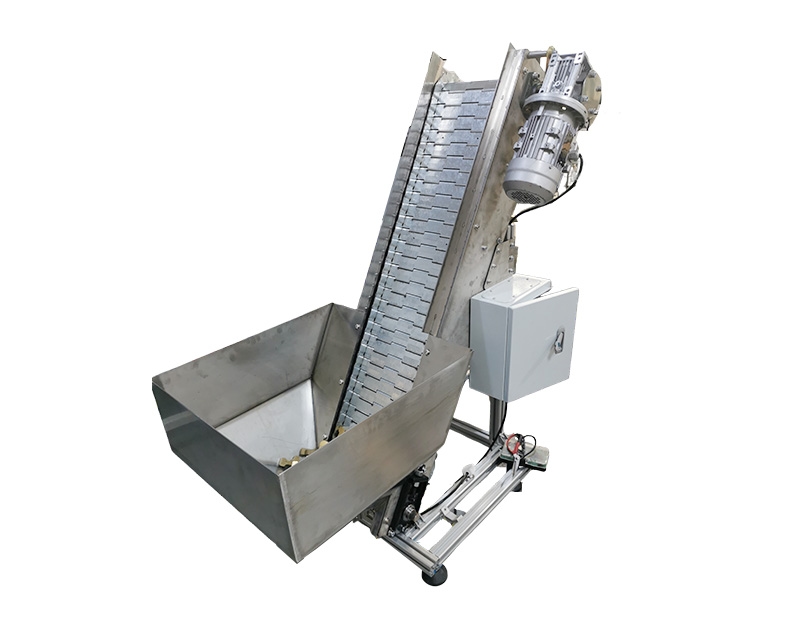
Overview
In modern industrial production systems, efficient material transportation is a key link to ensure smooth operation of production lines. Compared to horizontal transportation, vertical material lifting often faces greater challenges, and chain plate hoists, with their unique structural design and powerful performance, have become the core equipment to solve the challenges of vertical material conveying. From mining to food processing, from chemical production to logistics and warehousing, chain plate hoists play an indispensable role in various industries with stable and efficient performance, acting like the "backbone" of industrial production and supporting the heavy responsibility of vertical material transportation.
The working principle of the chain plate hoist is based on the coordinated movement of the chain and chain plate, driving the material vertically or at a steep angle through power drive. Its core structure consists of the drive unit, traction chain, load-bearing chain plate, tensioning device, casing, and feed/outlet ports. The drive unit is the power source of the chain plate hoist, usually consisting of a motor, reducer, and coupling. The power output from the motor is decelerated and torque increased by the reducer, then transmitted via the coupling to the driving sprocket, driving the traction chain to operate. As the core transmission component, the traction chain is made of high-strength alloy steel, featuring high tensile strength and strong wear resistance, capable of withstanding large loads. The carrier chain plate is mounted on the traction chain and is responsible for carrying and conveying materials. Its shape and size can be customized according to material characteristics, commonly including flat, wave, and bucket types. For example, when conveying granular materials, flat chain plates can be used; For conveying powdered materials, a wave chain plate is suitable to prevent material spillage. The tensioning device adjusts the tension of the traction chain, ensuring the chain maintains proper tension during operation and preventing slippage or chain detachment. The casing serves to protect the internal structure and prevent material leakage. It is generally welded from steel plates, offering excellent sealing and protection. The design of the inlet and outlet ports is tailored to actual production needs, enabling continuous feeding and uniform unloading to ensure continuous and stable material conveying. During operation, the drive device drives the active sprocket to rotate, and the traction chain circulates under the sprocket's power, causing the load-bearing chain plate installed on the chain to move accordingly. After the material enters through the feed inlet, it is lifted and lifted upward by the chain plate. Upon reaching the discharge port, due to gravity and the inertia of the chain plate's movement, the material is smoothly discharged, completing the entire conveying process. Throughout the process, all components work together to form an efficient and stable vertical conveying system.
In mining and metallurgy, chain plate hoists are commonly used to transport ore, powder, coke, and other materials. Because mining materials are usually heavy, hard, and highly abrasive, the load-bearing capacity and wear resistance of hoisting equipment are extremely demanding. The chain plate hoist uses high-strength chains and wear-resistant chain plates, capable of withstanding enormous material weights and friction to ensure long-term stable operation. In open-pit mines, chain plate hoists can vertically lift mined ore from the mining face to the ground transportation system; In the concentrator plant, it is used to transport crushed ore to subsequent processes such as screening and grinding; In metallurgical plants, raw materials such as coke and iron ore can be lifted to the top of the blast furnace, enabling continuous and efficient feeding operations. For example, after adopting a chain plate hoist at a large iron mine, ore conveying efficiency increased by 40%, equipment failure rates significantly decreased, and production progress was effectively ensured.
The food and pharmaceutical industries have strict requirements for the hygiene, safety, and stability of material handling equipment. Chain plate hoists also play an important role in these fields. Its chain plates and chains are usually made of stainless steel, with smooth surfaces that are easy to clean, meeting food-grade and pharmaceutical-grade hygiene standards and effectively preventing material contamination. In food processing plants, chain plate elevators can be used to transport finished products such as biscuits, candies, bottled beverages, as well as raw materials like flour and grains. For example, in the biscuit production line, the chain plate elevator transports baked biscuits from the oven to the packaging station smoothly without damaging the shape or appearance of the biscuits. In the pharmaceutical industry, chain plate elevators are used to transport drug packaging materials, semi-finished and finished products, ensuring that medicines are not contaminated during transport and meet GMP (Good Manufacturing Practice) requirements.
The chemical and building materials industries come in a wide variety of materials with diverse properties, including highly corrosive chemical raw materials and heavy building materials. Chain plate hoists can be specifically designed according to different material characteristics to meet diverse conveying needs. For corrosive materials in the chemical industry, chain plate hoists can use corrosion-resistant special materials such as stainless steel and PTFE for chain plates and chains, and are equipped with well-sealed casings to prevent material leakage and volatilization. In the building materials industry, chain plate hoists are commonly used to transport cement, sand, bricks, and other building materials. For example, on cement production lines, chain plate elevators lift the finished cement products after grinding to storage warehouses or packaging workshops. Their large conveying capacity and high stability can meet the demands of large-scale continuous cement production.
Features
- Process-configured architecture
- Documented mechanical and electrical interfaces
- Sensor and control options available
Benefits
- Reduces repetitive manual handling
- Presents parts consistently to the next process
- Supports integration with automated equipment
PARTS
Supported parts
- Parts evaluated according to the assembly process
- Components with special handling requirements
- Applications combining feeding, sorting and conveying
Want to evaluate this solution with your part?
Send photos, dimensions, orientation and rate. We will respond with the next technical questions.
Request a quote