NEXOFEED / products
Counting Vibratory Bowl Feeder
Against the backdrop of continuous advancement in industrial automation, efficient and precise material handling has become a key link to improving production efficiency and ensuring product quality. As an automated device integrating material conveying, directional sorting, and…
Evaluate with my part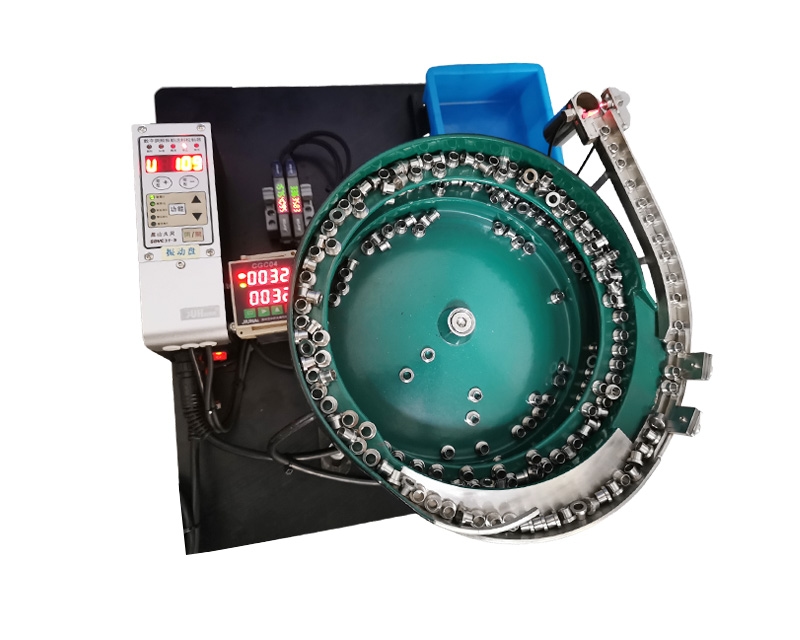
Overview
Against the backdrop of continuous advancement in industrial automation, efficient and precise material handling has become a key link to improving production efficiency and ensuring product quality. As an automated device integrating material conveying, directional sorting, and precise counting, counting vibratory bowl feeder play an important role in many industries due to their unique technical features. This article will thoroughly analyze the working principle, core advantages, application scenarios, challenges faced, and future development trends of counting vibratory bowl feeder, comprehensively showcasing the value of this smart device.
The counting vibratory bowl feeder is an automated device that integrates mechanical vibration, electrical control, and precision counting technology. Its workflow mainly covers four core steps: vibration conveying, directional sorting, precise counting, and stable feeding. When the equipment is started, a vibrating motor or piezoelectric ceramic installed at the bottom of the vibratory bowl feeder serves as the power source and begins operation. The vibrating motor generates centrifugal force through the high-speed rotation of the eccentric block, which in turn causes vibration of the vibratory bowl feeder; Piezoelectric ceramics use the inverse piezoelectric effect to cause mechanical deformation under the influence of an electric field, resulting in vibration. This vibration is transmitted at a specific frequency and amplitude to the hopper of the vibratory bowl feeder, causing the messy and disordered material inside to begin moving upward along the spiral track. On the spiral track, a specialized sorting structure is designed based on the shape, size, weight, and other characteristics of the material. These structures, through designs such as grooves, bosses, and notches, can precisely select materials that match specific postures, allowing them to be oriented during movement. Materials with incorrect posture will fall back into the hopper due to gravity or vibration, re-entering the sorting process. After multiple rounds of screening and adjustment, precise material orientation is achieved. Once the aligned material is completed, it continues to be conveyed along the track, at which point the counting system comes into play. Counting vibratory bowl feeder typically use photoelectric sensors, capacitive sensors, or weighing sensors to count materials. Taking the photoelectric sensor as an example, when material passes through the sensor's sensing area, it blocks the light. The sensor converts the light signal into an electrical signal, and the counting control system records the number of changes in the electrical signal, thereby achieving precise statistics of material quantity. In addition, some high-end counting vibratory bowl feeder are equipped with image recognition technology, capturing material images with high-definition cameras and using image processing algorithms to analyze the quantity of materials in the images, further improving counting accuracy. Then, the counted material is delivered to the designated position at a stable beat by auxiliary mechanisms such as a straight vibrator or blowing device, achieving precise feeding. Throughout the process, the electrical control system precisely controls material conveying speed, counting accuracy, and feeding rhythm by adjusting the frequency and amplitude of the vibration motor, as well as controlling the operation of the counting system and auxiliary mechanisms, ensuring stable and efficient counting and feeding processes.
The counting vibratory bowl feeder can achieve extremely high counting accuracy, with a counting error rate controlled within ±0.1%. Whether it's small electronic components, hardware parts, or granular and sheet-like industrial materials, precise counting can be performed. For example, in the production process of electronic chips, the number of chips in each batch requires precise statistics. The counting vibratory bowl feeder, using advanced sensors and algorithms, can accurately complete chip counting tasks, providing reliable data support for subsequent packaging and testing processes, effectively avoiding production chaos and resource waste caused by counting errors.
Compared to traditional manual counting and feeding methods, the efficiency advantages of counting vibratory bowl feeder are obvious. Under continuous operation, it can process 80 to 150 materials per minute, with processing speeds depending on material type and complexity, significantly improving production efficiency. At the same time, the equipment uses high-quality materials and precision manufacturing processes, resulting in a stable structure and strong operational stability. The Mean Time Between Failures (MTBF) exceeds 10,000 hours, reducing production line downtime caused by equipment failures, ensuring production continuity, lowering maintenance costs and the risk of production delays for the company, and significantly improving production efficiency.
Different industries and production scenarios have varying requirements for material counting and feeding, and counting vibratory bowl feeder support highly customized designs. Manufacturers can personalize the shape of the hopper shape, track structure, sorting mechanism, and counting methods of the vibratory bowl feeder according to the specific needs of customers. For example, for fragile glass products, smoother and better cushioning tracks can be designed to prevent material damage during transportation; For irregularly shaped and irregularly shaped parts, a dedicated sorting structure can be customized to ensure accurate orientation and smooth counting; For counting tasks requiring different precisions, appropriate sensors and counting algorithms can be selected. This customization capability allows the counting vibratory bowl feeder to widely adapt to the counting and feeding needs of various materials, meeting diverse production requirements.
Features
- Part-specific orientation tooling
- Adjustable vibration and flow control
- Line-integration-ready interface
Benefits
- Reduces repetitive manual handling
- Presents parts consistently to the next process
- Supports integration with automated equipment
PARTS
Supported parts
- Metal or plastic parts validated through sample testing
- Components requiring repeatable orientation
- Small and medium parts suitable for vibratory feeding
Want to evaluate this solution with your part?
Send photos, dimensions, orientation and rate. We will respond with the next technical questions.
Request a quote