NEXOFEED / products
IV Catheter Component Vibratory Bowl Feeder
In modern medicine, indwelling needles have become core instruments in clinical infusion and blood transfusion treatments due to their convenience and safety. As the "invisible hero" in indwelling needle production, the vibratory bowl feeder of the indwelling needle assembly leve…
Evaluate with my part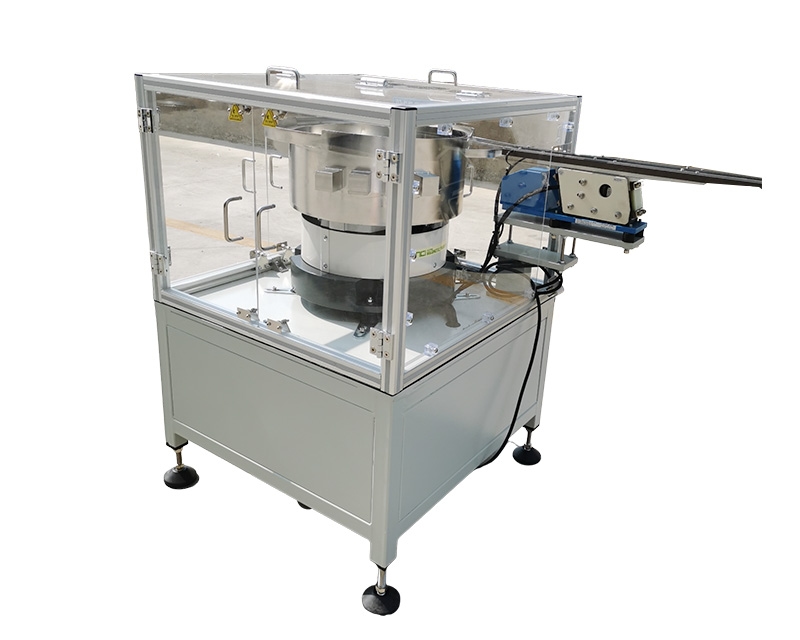
Overview
In modern medicine, indwelling needles have become core instruments in clinical infusion and blood transfusion treatments due to their convenience and safety. As the "invisible hero" in indwelling needle production, the vibratory bowl feeder of the indwelling needle assembly leverages precise automated conveying technology to ensure the efficient and orderly arrangement of dozens of tiny parts such as needle tips, catheters, and heparin caps, making it an indispensable intelligent conveying hub in medical precision manufacturing. Its technical level not only directly affects the production efficiency of indwelling needles but is also closely related to patient safety and treatment outcomes.
The vibratory bowl feeder for the indwelling pin assembly is a composite device that integrates mechanical vibration theory, precision manufacturing, and intelligent control technology. Its core lies in achieving automatic sorting and precise delivery of parts through vibration. The equipment mainly consists of four parts: the hopper system, vibration drive module, intelligent track components, and precision sorting mechanism. The hopper system, serving as a temporary storage space for parts, is made of food-grade 304 stainless steel, with a mirror-polished inner wall to prevent scratches from sharp parts during storage. The vibration drive module abandons the traditional single vibration motor mode and adopts multi-frequency composite vibration technology. By layering vibration waves of different frequencies, parts form a spiral upward motion inside the hopper. For example, when conveying thin-walled catheters, low-frequency vibration can reduce collisions and compression between parts; When transporting hard parts like metal needles, high-frequency vibrations can accelerate sorting efficiency. The intelligent track assembly is the technical core of the vibratory bowl feeder for the indwelling pin assembly. The track surface is treated with a nano-level coating, with a friction coefficient only one-third that of ordinary steel, ensuring parts remain undamaged during transportation. The track is equipped with various shapes of intelligent sorting grooves, such as triangular prism-shaped positioning grooves for the needle tip and threaded guide rails adapted to heparin caps. Through precise geometric matching, each part automatically adjusts to its preset posture during movement. When a part passes through the end of the track, the photoelectric sensor array performs millisecond-level detection of the part's dimensions and orientation, ensuring that the output part meets 100% assembly requirements.
The indwelling pin assembly contains 12 to 15 different specifications of parts, each with extremely stringent feeding requirements. Taking the stainless steel needle tip as an example, the vibratory bowl feeder uses magnetic levitation sorting technology to use a weak magnetic field to keep the needle tip top-up on the track, preventing direct contact between the needle tip and the track that could cause passivation. For polyurethane conduits, the vibratory bowl feeder uses a flexible cushioning conveying structure, with a silicone cushioning layer added to the track surface, and the conveying speed of parts is controlled through an air pressure adjustment system to prevent deformation or creases caused by compression. In practical applications at a medical device manufacturer, after adopting a customized indwelling needle assembly vibratory bowl feeder, the yield rate of needle tip feeding increased from 87% in manual operation to 99.6%, catheter damage rate dropped by 92%, and raw material waste was significantly reduced.
Modern indwelling needle production lines typically adopt a circular automated assembly model, with the vibratory bowl feeder serving as the front-end conveying device and requiring millisecond-level synchronization with more than 20 processes such as welding and packaging. Through the industrial Ethernet protocol, the PLC control system of the vibratory bowl feeder and the main control system interact with data in real time. When the assembly station detects a shortage of parts, the vibratory bowl feeder automatically increases the conveying speed by 30%; If assembly anomalies are detected, the vibratory bowl feeder immediately enters "standby - cache" mode to avoid part accumulation and clogging. At a large medical consumables production base, eight vibratory bowl feeder of indwelling needle assemblies worked in coordination with an automated assembly line, achieving a production speed of 120 indwelling needles per minute, an eightfold increase in efficiency compared to traditional manual feeding.
The medical industry has stringent requirements for production environments, and the vibratory bowl feeder for indwelling needle assemblies achieves clean production through multiple technologies. The equipment adopts a negative pressure dustproof design and a built-in HEPA filter capable of filtering particles larger than 0.3μm; Key components are treated with antibacterial coatings to inhibit bacterial growth. In a GMP-compliant cleanroom, the concentration of dust particles generated during the operation of the vibratory bowl feeder is always kept within ISO Level 5 standards, fully meeting the production environment requirements for medical consumables.
Features
- Part-specific orientation tooling
- Adjustable vibration and flow control
- Line-integration-ready interface
Benefits
- Reduces repetitive manual handling
- Presents parts consistently to the next process
- Supports integration with automated equipment
PARTS
Supported parts
- Metal or plastic parts validated through sample testing
- Components requiring repeatable orientation
- Small and medium parts suitable for vibratory feeding
Want to evaluate this solution with your part?
Send photos, dimensions, orientation and rate. We will respond with the next technical questions.
Request a quote