NEXOFEED / products
IV Catheter Three-Way Connector Feeder
In modern medical systems, indwelling needles have become commonly used medical devices in clinical care due to their advantages in reducing the pain of repeated puncture and facilitating long-term infusion therapy. As one of the core components of the indwelling needle, the qual…
Evaluate with my part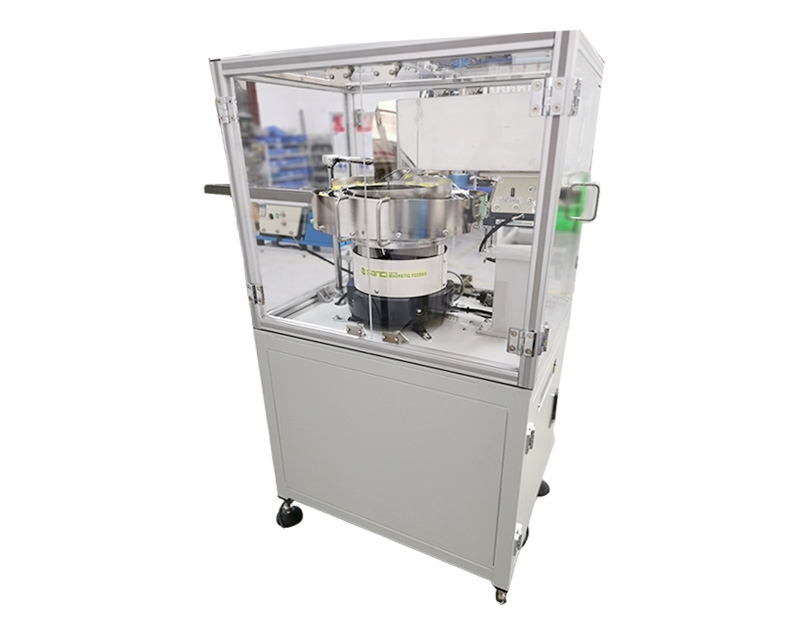
Overview
In modern medical systems, indwelling needles have become commonly used medical devices in clinical care due to their advantages in reducing the pain of repeated puncture and facilitating long-term infusion therapy. As one of the core components of the indwelling needle, the quality of the indwelling needle tee directly affects the safety and effectiveness of the infusion process. In the production process of the retaining needle tee, the vibratory bowl feeder plays an irreplaceable role. Through precise part arrangement and conveyance, it provides a solid guarantee for the production of high-quality retaining needle tees, serving as a key support in the precision production line of medical devices.
The retaining pin tee vibratory bowl feeder is a device based on vibration principles that enables automatic sorting and conveying of parts. Its design is highly suited to the production requirements for small and high-precision components of the retained pin tee. The equipment mainly consists of a hopper, chassis, vibration motor, spiral track, sorting mechanism, and discharge port. The hopper is a container for storing retaining pin tee parts, and its capacity can be designed according to production requirements. The chassis provides stable support for the entire vibratory bowl feeder and is equipped with a vibration motor. The vibration motor, as the power source of the vibratory bowl feeder, generates high-frequency vibrations to transmit power to the hopper. When the vibrating motor starts, the hopper generates vertical vibration and torsional oscillation around the vertical shaft. Inside the hopper, various parts of the retaining pin tee, such as tee joints, valves, and sealing rings, begin to move upward along a pre-designed spiral track under vibration. The surface of the spiral track is specially treated with appropriate roughness to ensure that parts move smoothly during movement without jamming due to excessive friction. At the same time, the track is equipped with sorting mechanisms of various shapes, which sort and orient parts based on the shape, size, weight, and other characteristics of the retained pin tee parts. For example, for tee joints, the sorting grooves on the track can precisely clamp specific parts of the joint, allowing it to continue advancing in the specified direction and posture; For soft and easily deformed parts like sealing rings, the vibratory bowl feeder uses gentle vibration and special conveying methods to prevent damage during conveying. When the part rises along the spiral track to the top, it is output from the discharge port in an orderly and oriented state, directly entering the subsequent assembly process, achieving an efficient transition of the retained pin tee part from disorder to order.
The production of retaining pin tees involves multiple small components, and the installation position and orientation of each part must be precise to ensure sealing performance and operational safety. During the loading stage of parts, the vibratory bowl feeder can precisely separate and arrange these components. Take the tee joint as an example: its shape is complex, with multiple interfaces and channels. Under the action of the vibratory bowl feeder, the joint continuously adjusts its posture along the track, then is neatly conveyed to the assembly station in a specific upward or downward direction. For valve components, the vibratory bowl feeder uses specially designed tracks to arrange the valve's opening and closing positions in a specified direction, facilitating subsequent assembly with the joint. As a key component to ensure the sealing performance of the tee, the vibratory bowl feeder uses a gentle vibration mode and buffering structure during conveying to prevent deformation or scratches, ensuring its sealing performance is not compromised. In actual production, after a well-known medical device company introduced a resident needle tee vibratory bowl feeder, the feeding efficiency of the tee parts increased by 50%, and the accuracy of part arrangement reached 99.8%, greatly enhancing production efficiency and product quality stability.
Modern production of the retaining pin tee usually uses automated assembly lines. As an important front-end device, the vibratory bowl feeder of the retaining pin tee needs to be seamlessly integrated with subsequent assembly equipment. The position of the discharge port and conveyor speed of the vibratory bowl feeder can be precisely adjusted according to the rhythm of the assembly line. After the vibratory bowl feeder delivers parts to the discharge port, they are quickly and accurately transferred to the assembly station via conveyor belts or robotic arms. During this process, information exchange occurs between the vibratory bowl feeder and the assembly equipment via sensors and control systems. For example, when the number of parts at the assembly station is insufficient, the sensor sends a signal to the vibratory bowl feeder, which automatically speeds up the conveying speed; When parts accumulate at the assembly station, the vibratory bowl feeder pauses or slows down the conveying to prevent parts from clogging and damage. This efficient connection method enables the entire production process of the indwelling needle tee to be automated and continuous, reducing manual intervention, lowering quality issues caused by human factors, while also improving production efficiency and lowering production costs.
After the production of the indwelling needle tee is completed, strict quality testing is required to ensure the product meets relevant medical device standards. vibratory bowl feeder also play an important pretreatment role in quality inspection. Parts arranged and conveyed by the vibratory bowl feeder enter the quality inspection equipment in a neat and orderly state. This enables inspection equipment to inspect parts more quickly and accurately, improving inspection efficiency. For example, in appearance inspection, because parts are neatly arranged, visual inspection equipment can scan each part according to fixed procedures and parameters, avoiding missed inspections or misjudgments caused by chaotic part positioning. In the dimensional inspection stage, the orderly arrangement of parts also facilitates precise measurements by measuring instruments, ensuring the accuracy of inspection results. Through pretreatment of the vibratory bowl feeder, the quality inspection process for the indwelling needle tee becomes smoother, enabling timely detection and removal of defective products, ensuring the quality of products leaving the factory.
Features
- Part-specific orientation tooling
- Adjustable vibration and flow control
- Line-integration-ready interface
Benefits
- Reduces repetitive manual handling
- Presents parts consistently to the next process
- Supports integration with automated equipment
PARTS
Supported parts
- Metal or plastic parts validated through sample testing
- Components requiring repeatable orientation
- Small and medium parts suitable for vibratory feeding
Want to evaluate this solution with your part?
Send photos, dimensions, orientation and rate. We will respond with the next technical questions.
Request a quote