NEXOFEED / products
Vision-Guided Flexible Feeding System
Driven by the wave of Industry 4.0 and intelligent manufacturing, the traditional rigid production model has gradually revealed drawbacks such as lack of flexibility and high replacement costs, while flexible production has become the key direction for manufacturing transformatio…
Evaluate with my part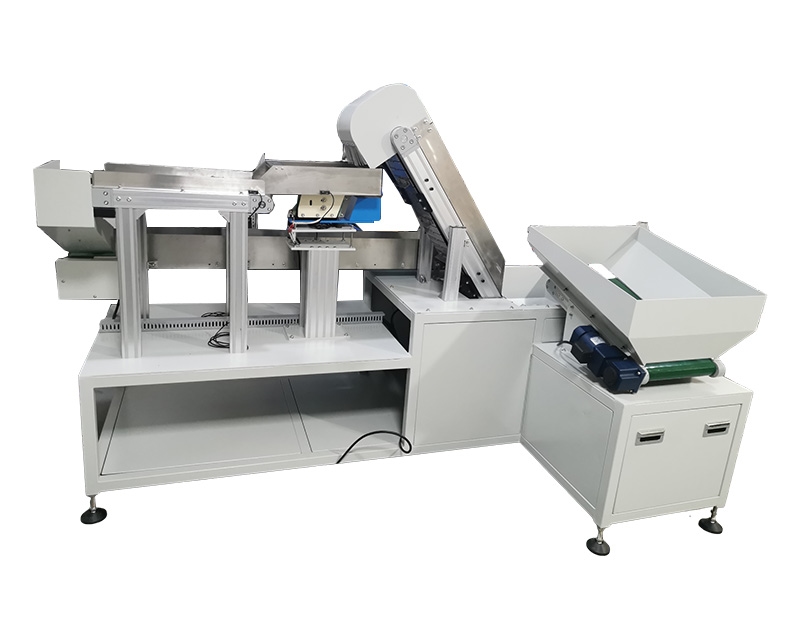
Overview
Driven by the wave of Industry 4.0 and intelligent manufacturing, the traditional rigid production model has gradually revealed drawbacks such as lack of flexibility and high replacement costs, while flexible production has become the key direction for manufacturing transformation and upgrading. As an innovative product integrating artificial intelligence visual recognition and automated control technology, the flexible visual feeding system breaks the limitations of traditional feeding equipment and provides industrial production with high-precision, highly adaptable material handling solutions. From electronics manufacturing to automotive parts production, from food packaging to medical device assembly, flexible visual feeding systems are reshaping the landscape of industrial automation with disruptive technological advantages.
The flexible visual feeding system is not a single piece of equipment, but an intelligent solution composed of three core units: visual recognition module, intelligent control system, and flexible actuator. Its workflow follows the logical thread of "perception - analysis - execution," achieving an automated closed loop from disorganized material loading to precise feeding. The visual recognition module, acting as the "eyes" of the system, is usually equipped with industrial-grade high-definition cameras, line laser sensors, or 3D vision devices. For example, in electronic chip feeding scenarios, high-resolution industrial cameras can achieve micron-level image acquisition, and when combined with auxiliary devices such as ring light sources and coaxial light sources, they can clearly capture minute features on the chip surface. After transmitting the collected image data to the intelligent control system, deep learning algorithms (such as convolutional neural networks (CNN) perform feature extraction and pattern recognition, enabling the system to analyze and judge material types, dimensions, positions, postures, and other information within milliseconds. The intelligent control system is the "brain" of the flexible visual feeding system. It is built on PLCs (Programmable Logic Controllers) or industrial computers, integrating motion control algorithms, path planning algorithms, and real-time decision models. Once the system recognizes material information, the control system calculates optimal picking paths and action parameters based on preset process requirements combined with the kinematic models of the robot or manipulator. For example, for irregularly shaped automotive parts, the system uses collision detection algorithms to plan interference-free grasping trajectories to avoid collisions with surrounding materials or equipment. The flexible actuator acts as the system's "hands," usually composed of collaborative robots, vacuum suction cups, grippers, and so on. These actuators are highly flexible and can quickly switch according to material characteristics. For example, for fragile glass products, vacuum suction cups with negative pressure adsorption are used; For metal parts, high-precision electric grippers are used. Under the command of the control system, the actuator precisely completes the picking, handling, and placement of materials, with the entire process error controlled within ±0.1mm.
Traditional feeding equipment such as vibratory bowl feeder and belt conveyors are usually designed for a single type of material, and a significant amount of time is spent adjusting equipment parameters during mold change production. The flexible visual feeding system, through software algorithms and modular hardware design, enables rapid switching between multi-variety and small-batch production. In 3C product manufacturing, a company adopted a flexible vision feeding system and was able to complete production switching of more than 10 different materials such as mobile phone motherboards and camera modules within 15 minutes, improving production efficiency by 40% and equipment utilization to 85%. The system supports rapid import of visual recognition models and grabbing strategies for new products through a graphical programming interface, eliminating the need for large-scale hardware modifications and significantly lowering the threshold for flexible production for enterprises.
Thanks to advanced visual recognition and motion control technologies, flexible visual feeding systems can overcome the accuracy bottlenecks of traditional mechanical positioning. In the lithium battery electrode sheet loading stage, the system uses 3D visual scanning technology to accurately detect the warpage and edge profile of the electrode sheets. Combined with a micron-level positioning robotic arm, the placement error of the electrode sheet is controlled within ±0.05mm, meeting the stringent material positioning requirements of lithium battery production. In addition, the system also features real-time deviation correction capabilities. When a material is detected to shift position during conveying, the control system dynamically adjusts the picking and placement coordinates to ensure the material always stays within the required tolerance range for the process, effectively improving the product yield rate.
In industrial production scenarios, materials may face complex issues such as stacking, adhesion, and surface reflection, which traditional feeding equipment often struggles to handle. Flexible vision feeding systems, leveraging deep learning algorithms and multimodal perception capabilities, can effectively solve such challenges. In hardware sorting scenarios, the system uses multi-view image fusion technology to accurately identify stacked metal parts and plan a collision-free picking sequence; For reflective metal surfaces, a combination of structured light projection and polarized light imaging is adopted to eliminate reflection interference and achieve stable feature recognition. After an automotive parts factory introduced this system, the loading success rate under complex conditions increased from 75% to 98% of manual operations.
Features
- Recipe-based product changeover
- Machine vision and robotics compatible
- Controlled part handling
Benefits
- Reduces repetitive manual handling
- Presents parts consistently to the next process
- Supports integration with automated equipment
PARTS
Supported parts
- Part families with frequent variants
- Delicate components requiring controlled handling
- Parts suitable for machine-vision localization
Want to evaluate this solution with your part?
Send photos, dimensions, orientation and rate. We will respond with the next technical questions.
Request a quote