GUÍA TÉCNICA
A useful electronic connector feeder enquiry explains what the assembly station needs to receive. “We need a bowl feeder for this connector” identifies a broad task, but it leaves important questions unanswered: which face matters, which variants are included, whether contacts are installed, and what the next tool uses to locate the component.
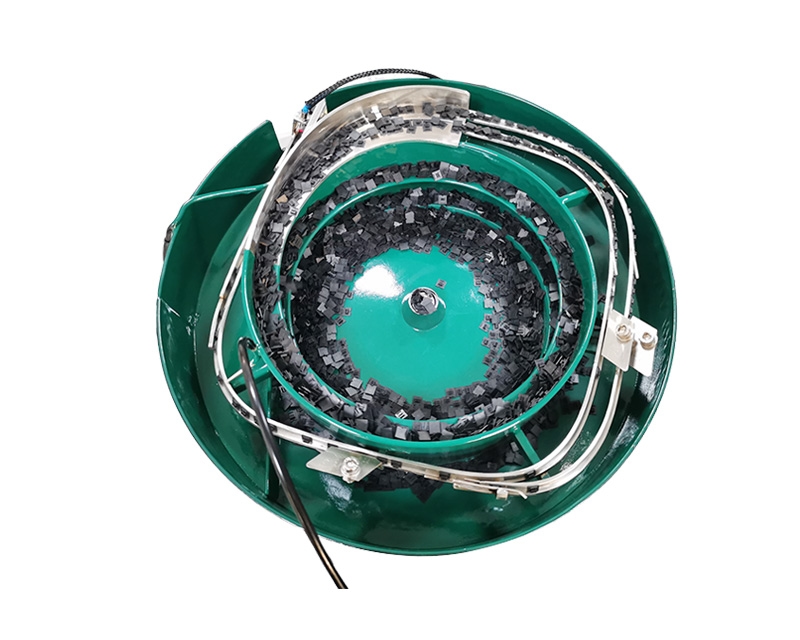
The NexoFeed YH-750 Electronic Connector Vibratory Bowl Feeder is listed for a part-specific feeding evaluation. Its specification leaves configuration and rate to confirmation with the part and process. A structured request for quotation helps turn that open application into a proposal that can be reviewed and tested.
View the application workflow diagram (conceptual illustration)
Make a connector-family matrix
List every part number intended for the proposed cell, with its drawing revision and assembly state. Compare external dimensions, keying, latch locations, cavity arrangement and any feature used for support. State which differences are functional and which are appearance-only; do not leave the supplier to infer that from photographs.
Separate confirmed production variants from possible future additions. A request that casually combines both can produce an unclear quotation. Ask the supplier to identify the evaluated scope and the engineering work required for any later variant. This makes future compatibility a controlled decision rather than an assumed promise.
Define the receiving datum
Describe how the next operation locates the connector. The required datum may relate to a housing shoulder, a cavity face or another feature shown on the component drawing. Mark the desired pose at the actual receiving position, including any rotational distinction.
Consider whether the feeder must establish the complete position or only a stable pre-orientation. The receiving fixture may complete the final location. This division matters when evaluating tooling complexity and access. It also prevents the same locating task from being specified inconsistently by the feeder supplier and the assembly-machine integrator.
State the component's assembly condition
A bare housing and a connector containing contacts can require different handling precautions. Explain whether seals, secondary locks or other components are already present. If the loaded item includes wires or attached elements, show the complete assembly and its permitted handling state.
The electronics industry uses several feeding approaches, including dedicated bowl systems and flexible arrangements, depending on the component and assembly task. RNA's electronics application overview illustrates that variety. It should not be read as a performance claim for NexoFeed equipment. See the industry application overview.
Mark support regions and keep-out features
Provide a drawing distinguishing allowable contact areas from latches, cavity edges, contact tips or other features that must be protected. The most obvious feature for recognizing orientation is not necessarily a suitable surface for a guide.
Discuss the complete path through the proposed arrangement. A component may rest safely in the bowl but contact a protected feature at the discharge or release point. The review should include any return path and waiting position, because repeated circulation and queue behavior are part of the actual handling task.
Define what must be inspected
Separate orientation, identity and component quality. They are related but different requirements. A connector can be oriented correctly yet be the wrong variant. It can also be the correct variant while containing an unacceptable feature. Identify which conditions the feeding system must check and which are controlled elsewhere.
For any requested automatic inspection, state the challenge conditions and the required response. Do not simply add “vision inspection” to the enquiry without defining the defect or distinction to be detected. A meaningful scope describes the decision the system must make and how that decision will be verified.
Describe demand as a sequence
Give the expected receiving-machine cycle and explain normal pauses, changeovers and replenishment. Identify whether parts are requested individually, accumulated in a queue or presented to a picking operation. The quoted output should correspond to the accepted presentation at that point.
Avoid using a single peak-rate number as the entire requirement. Two cells with the same average demand can need different buffering and release behavior. Explain the sequence that the feeder will actually support, including the conditions under which the receiving position cannot accept another component.
Include layout and service access
Supply the available envelope, required discharge height and receiving-tool access. Identify nearby equipment, guarding and operator routes that could restrict replenishment or inspection. A layout review should consider how the system is maintained as well as how it fits during normal operation.
State any requirement to remove tooling for changeover or cleaning. Ask how those tasks will be performed without disturbing an accepted interface unnecessarily. If access depends on moving another machine, that dependency should be recognized before a proposal is approved.
Build a representative sample package
Label samples by variant, supplier, revision and relevant production condition. Include normal variation that is permitted by the component requirements. Keep deliberately defective examples separate and identify them clearly for any agreed inspection challenge.
Provide an explanation of what the sample set does not cover. For example, a new variant may not yet have production parts available. Mark that limitation in the enquiry rather than allowing a prototype trial to be interpreted as validation of every future production condition.
Make acceptance criteria reviewable
Agree how correct presentation, usable output and component condition will be assessed. Include the receiving interface and relevant stop-start sequences in the trial. Record the circumstances of interventions instead of omitting them from the result.
A practical RFQ checklist includes:
- Evaluated connector variants and excluded future variants.
- Required pose, locating datum and protected features.
- Incoming assembly state and production sample identification.
- Receiving sequence, buffering and pickup responsibilities.
- Identification and inspection requirements.
- Layout, service access and changeover expectations.
- Observable acceptance criteria and trial limitations.
Review the proposal for scope gaps
Read the quotation against the checklist rather than comparing only equipment names. Look for assumptions about component condition, supplied tooling and the receiving station. Resolve differences before treating two proposals as equivalent.
Ask for clarification when a proposed function is described only as “available” or “optional.” Determine whether it is included in the quoted configuration and whether the acceptance trial covers it. This prevents a capability discussed during enquiry from being mistaken for a delivered feature.
Common questions
Can related connector variants share tooling?
Possibly, but the answer depends on their actual locating and support features. A family name does not establish shared-tooling compatibility.
Is vision always necessary?
No universal answer applies. Define the orientation or identity decision first, then evaluate the appropriate method with representative parts.
How do I begin the evaluation?
Send your connector RFQ package with reference YH-750. A clear variant matrix and receiving-datum drawing give engineering a more useful starting point than a photograph and target rate alone.