NEXOFEED / products
Airbag Igniter Tube Vibratory Bowl Feeder
In today's booming automotive industry, car safety performance has become an important factor for consumers when purchasing a vehicle. As the core component of a vehicle's passive safety system, airbags can deploy quickly in the event of a collision, providing crucial cushioning…
Evaluate with my part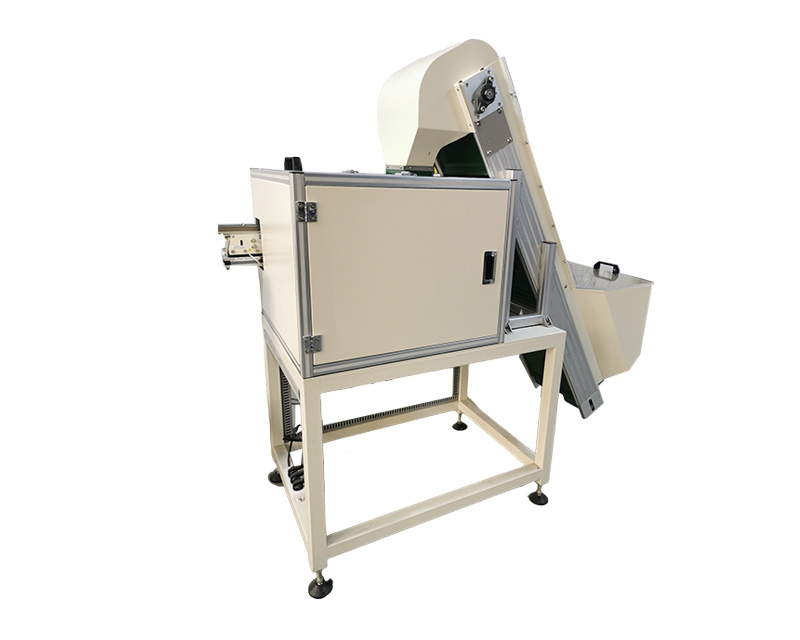
Overview
In today's booming automotive industry, car safety performance has become an important factor for consumers when purchasing a vehicle. As the core component of a vehicle's passive safety system, airbags can deploy quickly in the event of a collision, providing crucial cushioning protection for occupants. As the core component that triggers airbag deployment, the quality and production precision of the airbag ignition tube directly affect the airbag's reliability. As the core device for automating and precise transmission of ignition tubes, the airbag ignition tube vibratory bowl feeder plays an irreplaceable role in the manufacturing process of automotive airbags. This article will delve into the working principle, structural composition, application scenarios, advantages, common faults, and solutions of airbag ignition tube vibratory bowl feeder, providing a comprehensive analysis of how this precision device safeguards automotive safety manufacturing.
The working principle of the airbag ignition tube vibratory bowl feeder is based on the interaction between vibration and material movement. Through ingenious mechanical structure and power drive, it achieves precise arrangement and delivery of ignition tubes from disorder to order, providing stable support for subsequent assembly and inspection processes.
Most airbag ignition tube vibratory bowl feeder use electromagnetic drive. A pulse electromagnet is installed below the hopper of the vibratory bowl feeder. When powered on, the electromagnet generates a magnetic field that changes periodically. This magnetic field interacts with the armature inside the hopper, causing vertical vibration in the hopper. At the same time, due to the presence of inclined spring plates, the hopper not only vibrates vertically but also performs torsional oscillation around its vertical axis. This composite vibration mode causes the ignition tubes placed inside the hopper to be subjected to vibrational forces. Under the combined influence of vibration and gravity, the ignition tube begins to ascend along a spiral path. During ascent, the ignition tube passes through a series of carefully designed screening tracks and orientation devices. For example, notches, slopes, and baffles set on the track can screen ignition tubes that do not meet requirements (such as incorrect posture or incorrect dimensions), allowing them to return to the hopper for rearrangement. Only those ignition tubes that meet the requirements can smoothly pass through the track and proceed to subsequent assembly or processing positions. Operators can adjust the magnitude and frequency of the electromagnet's current to change the hopper's vibration amplitude and frequency, thereby adapting to the conveying needs of ignition tubes of different specifications and shapes.
Some airbag ignition tube vibratory bowl feeder require extremely high precision, using piezoelectric drive principles. At its core, it utilizes the inverse piezoelectric effect of piezoelectric ceramics. When an alternating electric field is applied to the piezoelectric sheet, the piezoelectric sheet undergoes corresponding stretching and contraction deformation, which in turn causes vibration. This vibration is transmitted to the chute via a specific transmission structure, driving the ignition tube to move inside the chute. Piezoelectric vibratory bowl feeder feature a simple structure, fast response speed, and high control accuracy. It does not require complex mechanical transmission components, reducing the likelihood of mechanical wear and failure. By changing parameters such as the amplitude, frequency, and pulse width of the drive signal, the intensity and frequency of vibration can be precisely controlled, achieving precise control of the ignition tube delivery speed and position. However, since the driving force of piezoelectric vibratory bowl feeder is relatively small, they are mainly suitable for conveying small, lightweight airbag ignition tubes, especially widely used in production lines for some miniature ignition tubes.
The hopper is the container used to store the airbag ignition tube, and its design directly affects the storage capacity and conveying efficiency of the ignition tube. Due to the small size and high precision of the ignition tube, the hopper is usually specially designed to prevent collisions and damage during storage. Common hoppers are cylindrical, but they are often equipped with soft cushioning materials or partition structures inside to separate the ignition tubes. The hopper material is generally made of anti-static and wear-resistant engineering plastics or stainless steel. These materials not only prevent accidents caused by static electricity caused by friction in the ignition tube, but also ensure the hopper is not easily damaged during long-term use. In addition, the internal flow guide structure design of the hopper is also crucial, as it guides the ignition tube to move along a specific path during vibration, preventing it from accumulating or clogging inside the hopper.
Features
- Part-specific orientation tooling
- Adjustable vibration and flow control
- Line-integration-ready interface
Benefits
- Reduces repetitive manual handling
- Presents parts consistently to the next process
- Supports integration with automated equipment
PARTS
Supported parts
- Metal or plastic parts validated through sample testing
- Components requiring repeatable orientation
- Small and medium parts suitable for vibratory feeding
Want to evaluate this solution with your part?
Send photos, dimensions, orientation and rate. We will respond with the next technical questions.
Request a quote