TECHNICAL GUIDE
An equipment inquiry becomes much clearer when it identifies the condition of the component as well as its name. “Airbag igniter tube” can describe an application category, but that name alone does not establish what is inside the item, which manufacturing stage it belongs to or what equipment is suitable for it.
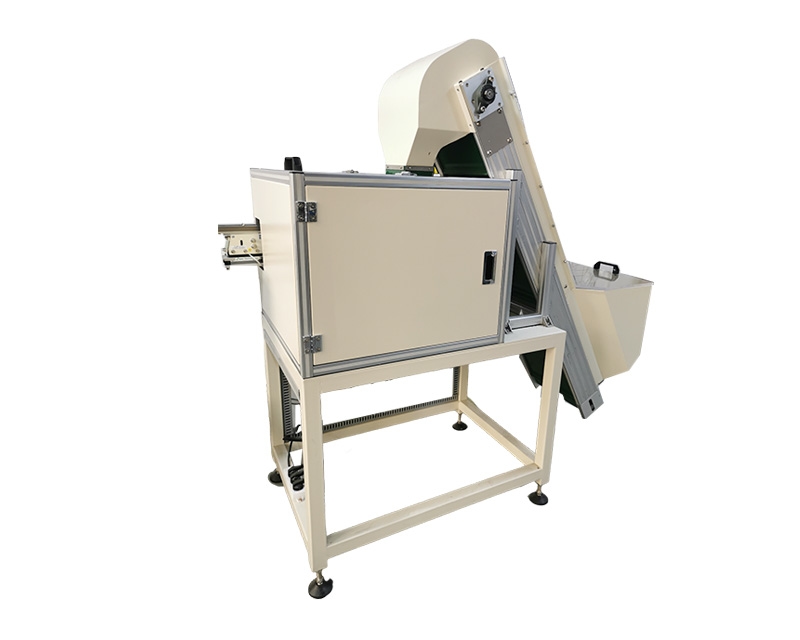
The NexoFeed YH-763 Airbag Igniter Tube Vibratory Bowl Feeder is listed as an application-specific catalog reference. Its configuration and capacity require evaluation. This article concerns empty, inert, non-energetic tubes only. The product title is not evidence that YH-763 is approved for loaded igniters, energetic materials or complete active assemblies.
View the application workflow diagram (conceptual illustration)
Define the component state before requesting a trial
Ask the component owner to identify the supplied state in writing. Provide the part number, drawing revision and manufacturing stage. Make the empty, non-energetic scope explicit in the project documents and obtain the supplier's agreement before arranging an evaluation.
If the supplied state is uncertain or differs from that scope, do not proceed under the assumptions in this guide. Refer the question to the component owner and appropriately qualified specialists. An ordinary feeding proposal cannot substitute for an application-specific equipment and safety assessment.
Describe geometry without reducing the part to diameter
Provide the complete drawing rather than only the nominal outside diameter. Show length, relevant end differences, allowable variation and the features used by the receiving operation. Include photographs that make the two ends and any external distinguishing features easy to compare.
A tube with similar overall dimensions can still need a different handling arrangement. The decision depends on its actual form, condition and delivery requirement. Avoid claiming interchangeability until the supplier has evaluated the proposed variants against the same defined receiving boundary.
Decide whether end direction matters
Some receiving operations require a particular end to arrive first. Others may treat both ends as equivalent for that specific step. Ask the process owner to establish the requirement from the drawing and downstream operation rather than inferring it from a photograph.
If direction matters, identify the feature that distinguishes the ends and explain how delivery will be assessed. If direction does not matter, record that decision explicitly. Unnecessary orientation constraints can complicate a project, while an overlooked constraint can invalidate an otherwise smooth feeding demonstration.
Identify contact and cleanliness restrictions
Mark protected surfaces and allowable support areas using the component owner's requirements. State whether the incoming condition includes any specified cleanliness or surface restrictions. Do not invent a cleanliness class or assume that a standard feeder provides cleaning, contamination detection or controlled-environment performance.
Ask the supplier to explain the proposed contact route and how the relevant condition will be checked during evaluation. Keep the quality requirement separate from the means proposed to achieve it. A smooth-looking demonstration is not a measurement of cleanliness or proof that a protected feature remains acceptable.
Define the handoff, not only the bowl exit
Show where the empty tube must arrive, its required pose and the receiving fixture's datum. Explain whether the receiving station takes an individual component from a defined point or accepts a controlled queue. Include the tool approach and any access restrictions.
Review the component's support through that boundary. The feeder's delivery concept and the receiver's acceptance concept must describe the same event. A part visible at the outlet is not necessarily ready for the next operation, especially when the receiving fixture imposes a different positional requirement.
Provide representative, identified samples
Samples should represent the approved incoming condition and the variants included in the project. Label them with traceable references and explain relevant differences. The supplier should not have to guess whether a visible variation is acceptable production, a different revision or a nonconforming example.
Keep any intentionally supplied nonconforming examples separately identified and agree their evaluation purpose in advance. Their behavior should not silently redefine acceptable production. The trial report needs enough context for another reviewer to understand which observations concern approved material and which concern exceptions.
State what the feeder is not expected to do
Define the boundary between presentation and inspection. If the project requires detection of a particular condition, describe that condition and the proposed verification responsibility separately. A component-presence signal does not automatically verify dimensions, identity, cleanliness or internal condition.
Likewise, do not describe the feeding system as qualifying a finished safety device. Empty-component handling and finished-product validation are different activities. Keeping those boundaries explicit helps the team assess the proposal without assigning unproven functions to mechanical orientation or delivery.
Agree how performance will be demonstrated
Use the receiving station's actual demand and representative material when defining an evaluation. Agree the observation period, normal interruptions and the information to record. The catalog does not establish a universal production rate for every empty tube or installation.
Record successful deliveries, interruptions, component-condition observations and interventions separately. An application-specific result is more useful when its conditions are visible. It should not be generalized to a different component state, tooling configuration or receiving arrangement without further assessment.
Prepare a focused inquiry package
A useful starting package contains:
- Written confirmation of the empty, inert component scope.
- The exact part number, revision and manufacturing stage.
- Drawings and photographs showing both ends and key features.
- Approved incoming condition and protected-surface requirements.
- Representative samples with clear identification.
- Receiving-fixture information and the required delivery pose.
- Defined inspection responsibilities and evaluation criteria.
Ask the supplier to identify remaining assumptions in its response. Resolve those assumptions before interpreting a quotation as a complete technical agreement. This approach keeps the discussion centered on an assessable empty-component application rather than on an ambiguous product label.
Questions buyers often ask
Does the catalog name establish suitability for loaded igniters?
No. A catalog title does not establish that scope or approval. This guide is limited to empty, inert components and cannot be used as an operating procedure for energetic assemblies.
Is orientation the same as inspection?
No. Presenting an empty tube in an agreed pose does not, by itself, verify every quality requirement. Define any inspection function independently and establish how it will be evaluated.
How can I begin an application review?
Request a YH-763 evaluation with the component-state declaration, drawing and receiving requirement. Ask the supplier to confirm the scope and unresolved questions before samples are submitted or performance expectations are agreed.